1. Three basic requirements (partially waived for spouses, etc.)
The first two requirements are waived for spouses and children of Japanese nationals, Permanent Residents, and Special Permanent Residents. Refugees and similar applicants benefit from a special provision on the independent livelihood requirement.
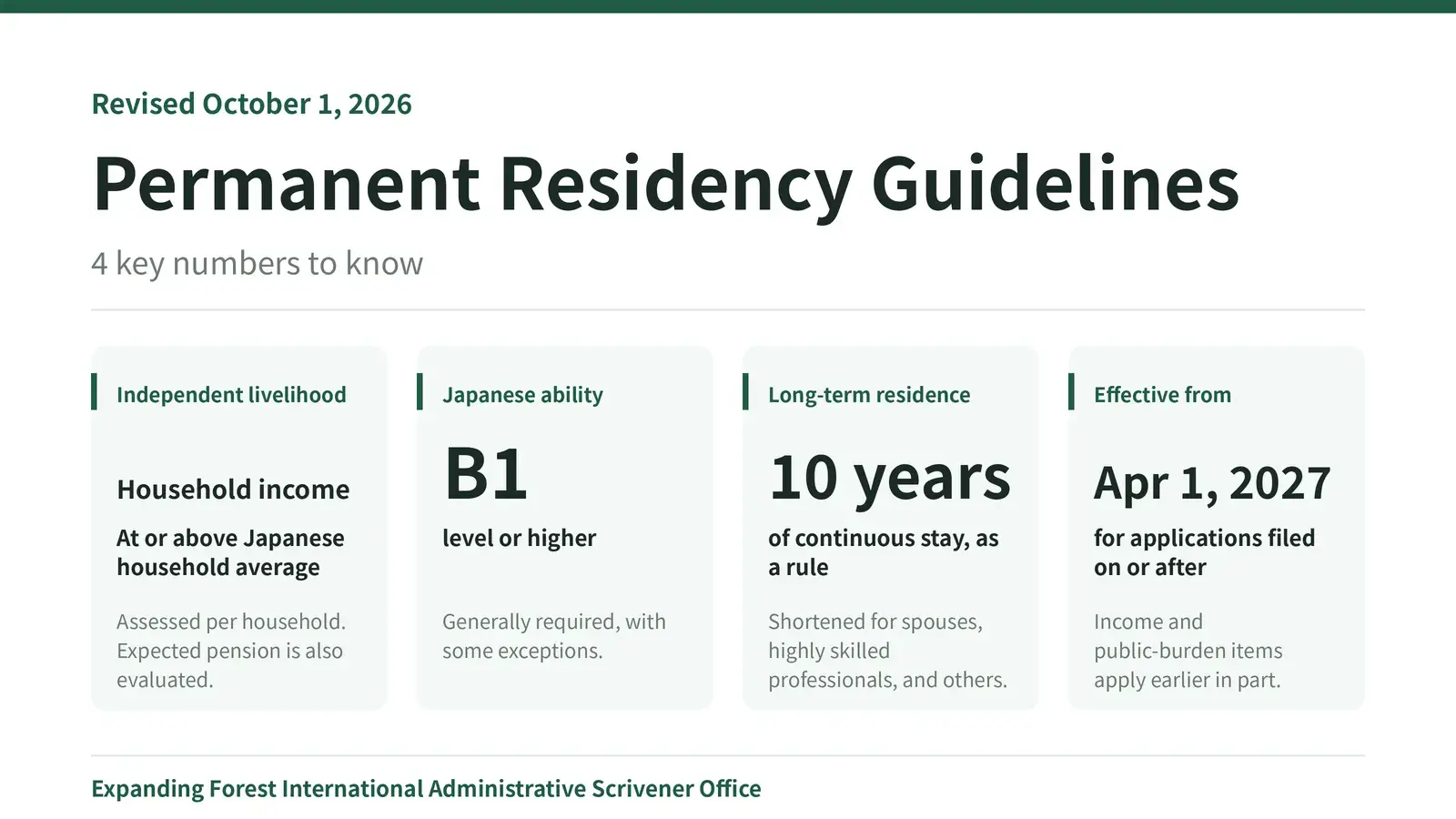
2. The "Independent Livelihood" Requirement Is Now Much More Concrete
Income standards that were previously left unstated have become a clear, household-based yardstick.
・Assessed on the basis of the household sharing the same livelihood
・Household annual income must continuously meet or exceed the average income of Japanese households of the same size
・Income from activities outside the scope of status, such as under "Dependent," is generally not counted
・Dependents, including those living overseas, are counted toward household size
・For households of five or more, an additional amount is added to account for higher living costs
Pensions are also a new evaluation item:
(a): Projected future pension amount, estimated from enrollment status and annual income
(b): Projected pension if the applicant had been enrolled in the Employees' Pension Insurance for 30 years at an income above the average Japanese household
If (a) is lower than (b), financial assets that can cover the shortfall are evaluated (the required amount varies with age)
3. The "National Interest" Requirement Is Significantly Expanded
In addition to tax payment and public obligations, the following items are now listed in detail. In principle, past violations are also evaluated negatively.
Exceptions to the Japanese language requirement: Highly Skilled Professionals and their families, and those who have received a cumulative total of 6 years or more of Japanese primary and secondary education.
4. Exceptions to the Standard 10-Year Residence Requirement (Maintained)
5. Examples of "contribution to Japan"
(The previous guideline has been abolished.)
Examples include the People's Honour Award and other national honors, international awards, executive officers of listed companies, achievements in academia, culture, the arts, and sports, and public service activities. These are favorably considered both for the 10-year rule exception and in the overall evaluation of the national interest requirement.
6. How periods under "Designated Activities" are counted
7. When the changes take effect
- As a rule, they apply to applications filed on or after April 1, 2027
- However, the items concerning annual income and public burden also apply to cases filed on or after April 1, 2026 that are still under review as of October 1, 2026
The key takeaway
The most notable points of this revision are the new B1-equivalent Japanese language requirement, and the appearance of concrete benchmarks: household income above the average Japanese household, plus a 30-year pension enrollment level.
If you have questions about this article, permanent residency, or other matters, please feel free to contact us.
If you have questions about this article, permanent residency, or other matters, please feel free to contact us.